Type-Safe Linear Algebra in F#
Matrix multiplication has a small but important precondition. If $A \in \mathbb{R}^{m \times n}$ and $B \in \mathbb{R}^{p \times q}$, then the product $AB$ exists only when $n=p$, in which case
\[AB \in \mathbb{R}^{m \times q}.\]Most compact matrix types store those dimensions only in their data, so an invalid multiplication remains possible until a runtime check rejects it.
The complete F# gist is an experiment in moving that check into the type system. Its compact set of matrix operations shows where types can carry the proof.
Dimensions that occupy no space
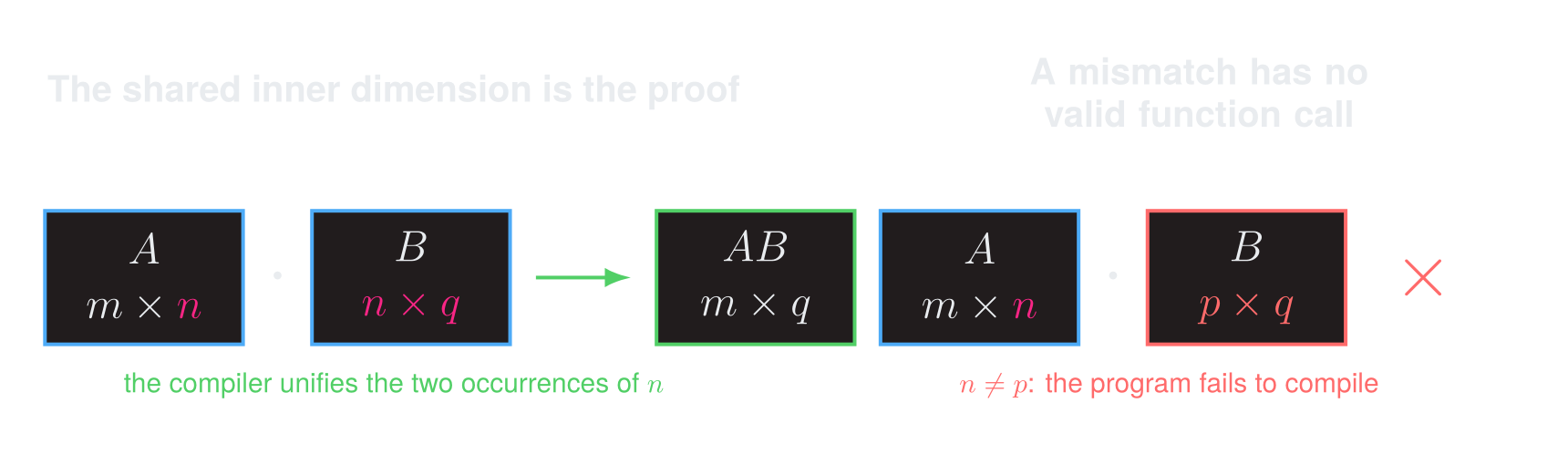
The example begins with four marker types, D1 through D4, and a matrix whose row and column dimensions are type parameters:
type Matrix<'rows, 'cols> = { Data: float[,] }
type Vec<'n> = Matrix<'n, D1>
These are phantom dimensions. A value of D2 is never stored in a matrix, and the runtime representation is still a two-dimensional array. The markers exist only while the compiler checks the program.
That makes the signature of multiplication do the interesting work:
let mul (a: Matrix<'r,'k>)
        (b: Matrix<'k,'c>) : Matrix<'r,'c>
The shared 'k says that the inner dimensions must be the same. At the type level, the function encodes
Multiplying a Matrix<D2,D3> by a Matrix<D3,D4> produces a Matrix<D2,D4>. By contrast, multiplying a Matrix<D2,D3> by a Matrix<D4,D2> does not compile, so the result-computing loop never runs.
Transpose, addition, and vectors extend the same idea. Transpose witnesses $\mathbb{R}^{r \times c} \to \mathbb{R}^{c \times r}$. Addition requires both operands to inhabit the same $\mathbb{R}^{r \times c}$. A column vector is simply a matrix with D1 as its column dimension, so matrix-vector multiplication needs no separate rule.
Let the expression preserve the proof
Custom operators make the examples read like their algebra. *. delegates to matrix multiplication, while +. delegates to addition:
let left = a *. b *. c
let av : Vec<D2> = a *. v
F# infers every intermediate dimension. In the first expression, a *. b must produce something that can be multiplied by c. In the second, the declared result type records the linear map
The gist also uses the language’s operator naming rules to make associativity visible. An operator beginning with * associates to the left, while one beginning with ^ associates to the right. Matrix multiplication is associative,
so both parses produce the same answer when their dimensions fit. The transpose example similarly checks the contravariant reversal
\[(AB)^{\mathsf T}=B^{\mathsf T}A^{\mathsf T}.\]The cross-product example at the end uses the same two operator spellings to show why grouping still matters for a non-associative operation: in general,
\[(\mathbf u \times \mathbf v) \times \mathbf w \ne \mathbf u \times (\mathbf v \times \mathbf w).\]Changing the operator changes the parse, and therefore the result.
What the types demonstrate
The shape of the API is the interesting part of the demonstration. Phantom markers make dimensional requirements explicit, and function signatures preserve those dimensions from one operation to the next. Matrix expressions then carry their own evidence of dimensional correctness as the compiler checks them.
The larger lesson is that a type parameter does not need runtime data to be useful. It can carry a fact from one operation to the next, turning a comment such as “these dimensions must agree” into a constraint the compiler enforces.